Covent Garden and Soho can suit first-time visitors who want theatres, restaurants and central sights nearby. South Bank and Southwark are other central options, while areas farther from the West End may suit travellers who prioritise a quieter setting or different transport links. The best base depends on your itinerary, budget and the exact hotel address. This guide compares nine areas and the trade-offs to check before booking.
Article Summary
| Question | Short answer |
|---|---|
| Best all-round base for a first trip? | Covent Garden or Soho can be convenient for theatres, dining, and central sights; check the exact hotel location. |
| Which central areas should I compare? | Compare South Bank, Southwark and London Bridge against your dates and transport needs; room rates vary by property. |
| Best for families with young children? | South Kensington for nearby museums and parks; room size and family facilities vary by hotel. |
| Best for nightlife and independent food? | Shoreditch and Spitalfields. |
| Calmest central areas? | Consider South Kensington, Marylebone, Notting Hill, St James’s or Bloomsbury, and check recent reviews for the specific street. |
| What should a first-timer avoid? | Do not rely on “central” in a listing; check the address, nearest station and journey times. |
| How many nights justify a Zone 1 rate? | Compare the total room cost with the journey time for your dates; there is no fixed night threshold. |
| Also covered | Tube zones, airport links, service charge and tips, and how to shape each day around your base. |
Best Areas to Stay in London for First-Time Visitors: At a Glance
| Area | Best for | Relative cost | Nearby sights or transport | Main trade-off |
|---|---|---|---|---|
| Covent Garden & Soho | First trips, theatre, food | Often premium; compare dates | Trafalgar Square, theatres, Chinatown; stations vary by address | Busy streets and possible night noise |
| Westminster & St James’s | Classic landmarks | Varies by property and date | Westminster Abbey, Parliament, St James’s Park | Some streets are quiet after office hours |
| South Bank, Southwark & London Bridge | Riverside sights and central access | Compare exact dates | Tate Modern, Borough Market, London Bridge; station access varies | Area is spread along the river |
| South Kensington & Hyde Park | Families, museums and parks | Varies by hotel and date | V&A, Natural History Museum, Science Museum | Evening options depend on the street |
| Marylebone & Fitzrovia | Dining, shopping and a quieter base | Compare exact dates | Marylebone High Street, Oxford Street, Regent’s Park | Walking distances vary across the area |
| Shoreditch & Spitalfields | Nightlife, markets and food | Compare exact dates | Brick Lane, Spitalfields Market, Liverpool Street connections | Some streets can be lively at night |
| Notting Hill & Bayswater | A residential feel and park access | Wide range; compare dates | Portobello Road, Hyde Park, nearby stations | Travel time depends on the exact address |
| The City of London | Business trips and St Paul’s | Weekend rates vary; check dates | St Paul’s, Barbican, transport hubs | Some businesses close at weekends |
| King’s Cross & Camden | Rail links, markets and varied budgets | Compare exact addresses | King’s Cross St Pancras, British Museum, Camden Market | Camden is farther north than King’s Cross |
For a short first visit, compare Covent Garden or Soho with South Bank and Southwark. Choose based on the sights you plan to visit, the hotel’s exact location and the total cost for your dates.
The Best Areas to Stay in London for a First Visit
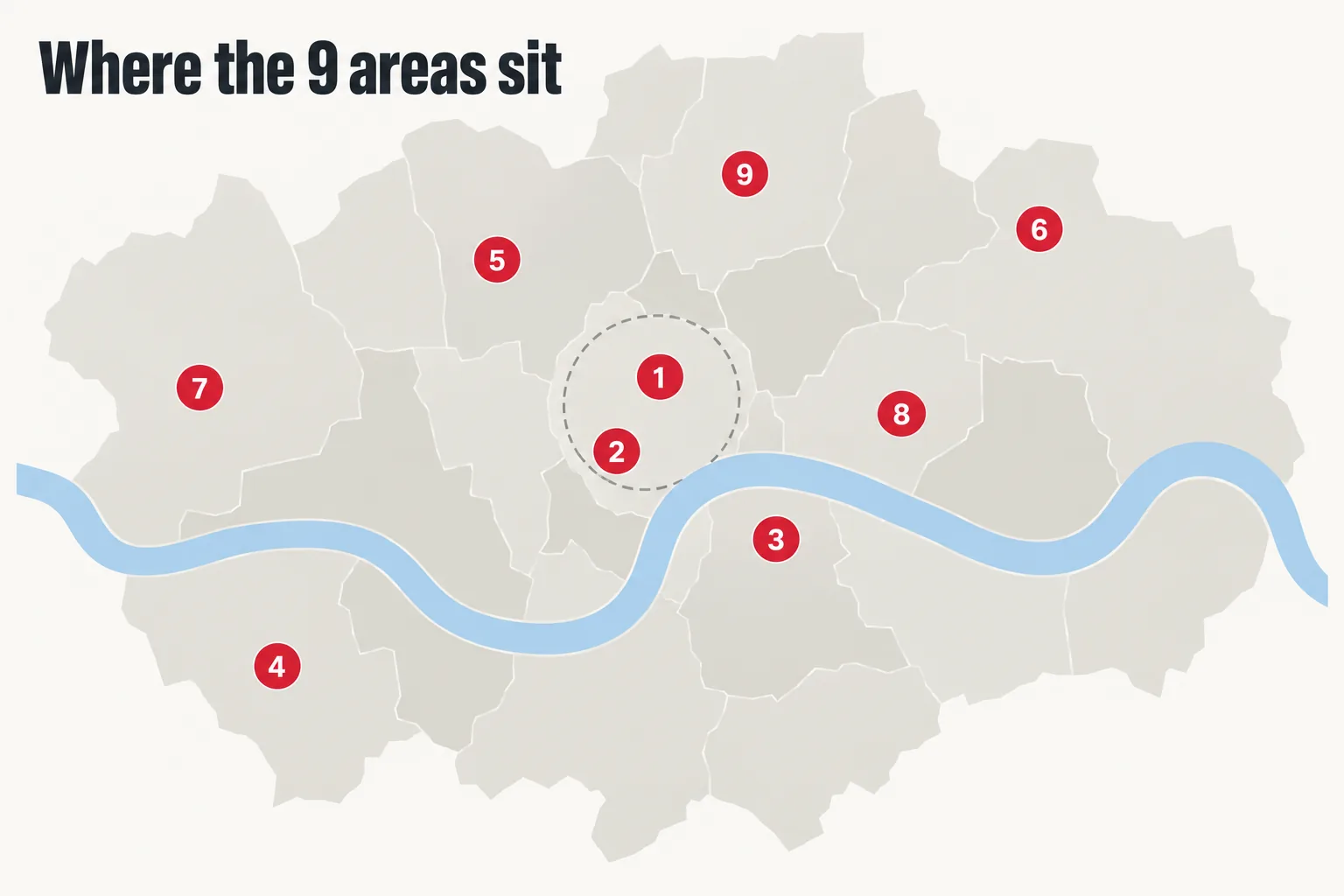
The comparisons below consider nearby sights, public transport, evening atmosphere, and relative cost. These factors can change within a neighbourhood, so use the hotel’s exact address when comparing listings.
Covent Garden and Soho: Theatre, Dining and Central Sights
Covent Garden and Soho put theatres, restaurants and several major sights within reach, but walking times and station options depend on the specific hotel. Some streets are lively late into the evening, so check recent guest reviews for noise. If your visit includes a group celebration, contact venues directly about private dining and availability. See P.S. London’s things to do in central London for nearby ideas.
Westminster and St James’s: Landmarks on the Doorstep
Big Ben, Westminster Abbey, Buckingham Palace, the Churchill War Rooms and St James’s Park form a tight walkable circuit, which suits a short trip built around the classic list. Early risers get the best of it: Westminster Bridge before nine is a different place from Westminster Bridge at noon. The trade-off is the evening. This is a government and office district, so restaurant choice thins out after 9 pm and the streets empty. Treat it as a daylight base and expect to walk one stop north for dinner. It pairs well with a broader hit list of the best things to do in London.
South Bank, Southwark and London Bridge: Riverside Sights and Transport
The South Bank and Southwark offer riverside routes to sights such as Tate Modern, Shakespeare’s Globe, Borough Market, the Southbank Centre and the London Eye. The areas cover a wide stretch, so check walking routes and station access from the exact hotel. Room prices and sizes vary by property and date. Borough Market can be busy at weekends; check its current opening information before planning a visit. Explore more things to do in south London.
South Kensington and Hyde Park: Museums and Green Space
South Kensington is convenient for the Natural History Museum, Science Museum and V&A, whose permanent collections are free to visit. Hyde Park and Kensington Gardens are also nearby, depending on your hotel address. Check the nearest station, airport route and current journey planner; room size, evening options and prices vary by property. Find more things to do in West London.
Marylebone and Fitzrovia: Shops, Dining and Park Access
Marylebone and Fitzrovia offer independent shops, restaurants and access to places such as the Wallace Collection and Regent’s Park. The feel can vary from one street to another, and some major sights will require a walk or Tube journey. For more local ideas, browse P.S. London’s guide to hidden gems in London.
Shoreditch and Spitalfields: For Nightlife and Independent London
Street art, Brick Lane, vintage stalls, Spitalfields Market and a bar and restaurant density few central districts match. If your trip leans toward food, music and late nights rather than palaces, base here and accept the compromise. Liverpool Street puts the Elizabeth and Central lines at your feet, along with fast trains to Stansted. The trade-off is real: no classic landmark is walkable, Westminster is a twenty- to twenty-five-minute Tube trip, and weekend nights stay noisy past closing time. First-timers who want both sides often split the trip, one night out east and the rest central. There is more than nightlife around here, as any list of things to do near Liverpool Street shows.
Notting Hill and Bayswater: Quiet Streets, Slower Pace
Pastel terraces, Portobello Road Market on Saturdays, Hyde Park at the eastern edge. Notting Hill proper is residential and expensive; the Bayswater side offers far more mid-range accommodation for the same postcode advantages. This base works best in warmer months, when the park, the canal walks up toward Little Venice and outdoor tables earn their keep. Two honest caveats: you sit on the edge of the sightseeing core, so most days open with a Tube ride, and Portobello is sleepy midweek. In June and July the calculation shifts, because several of London’s best summer spots sit within walking distance.
The City of London: Best for Short Business-Led Trips
St Paul’s Cathedral, the Tower of London, Tower Bridge and the Barbican all fall within a comfortable walk, and the Square Mile is the best-connected part of central London for onward rail. Rates often soften at weekends once the office population leaves, one of the few reliable discounts in Zone 1. That emptiness cuts both ways: some restaurants and cafés close on Sundays, and the streets feel stark after dark. Book here for a two- or three-night trip where efficiency matters more than atmosphere, and cross into Shoreditch or over the river for dinner. Keep an eye on new restaurant openings in London, since the City’s dining scene turns over quickly.
King’s Cross and Camden: Rail Links, Markets and Neighbourhoods
King’s Cross St Pancras is one of the best-connected stations in the country, with six Tube lines, national rail and Eurostar under one roof. Coal Drops Yard and Granary Square gave the area a reason to stay rather than pass through, and the British Museum is a fifteen-minute walk south. Camden, further north, brings lower nightly rates, a market that suits a younger crowd and a live music circuit, at the price of distance from the landmark cluster and heavy weekend congestion. The walk back from Camden at night is functional rather than scenic. Both sit inside a broader sweep of north London.
How to Match the Area to Your Trip Type
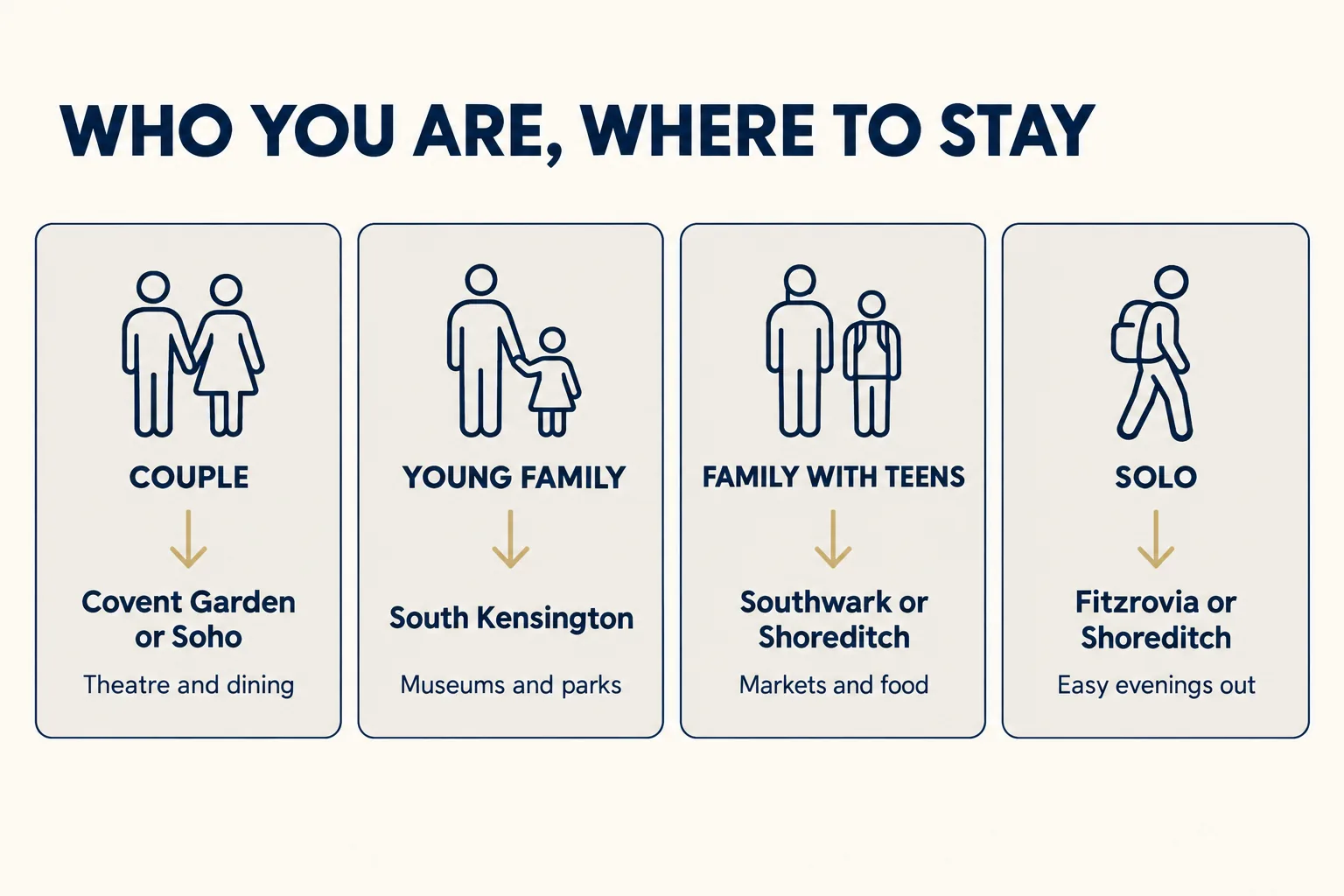
| Traveller type | Recommended area | Second choice | Why |
|---|---|---|---|
| First-time couple, 3–4 nights | Covent Garden or Soho | South Bank | Compare theatre and dining access with hotel price and street noise |
| Family, young children | South Kensington | South Bank | Compare nearby attractions, room configuration and hotel facilities |
| Family, teenagers | Southwark or Shoreditch | Camden | Consider markets, food options, activities and transport |
| Solo traveller | Fitzrovia or Shoreditch | King’s Cross | Check evening transport, dining options and the exact street |
| Older travellers or mobility needs | Choose based on confirmed access | Compare step-free routes and hotel facilities | Check station and hotel accessibility directly |
| Budget trip | Compare King’s Cross, Bayswater and other connected areas | Use exact travel dates | Compare the room price with route time and fares |
| Business trip extended into leisure | The City or a base near planned meetings | Choose by meeting location | Check venue and transport routes |
Families travelling with teenagers may want to balance museums with activities and downtime. P.S. London’s things to do in London with teenagers guide offers ideas to consider.
How to Compare Hotel Listings Before Booking
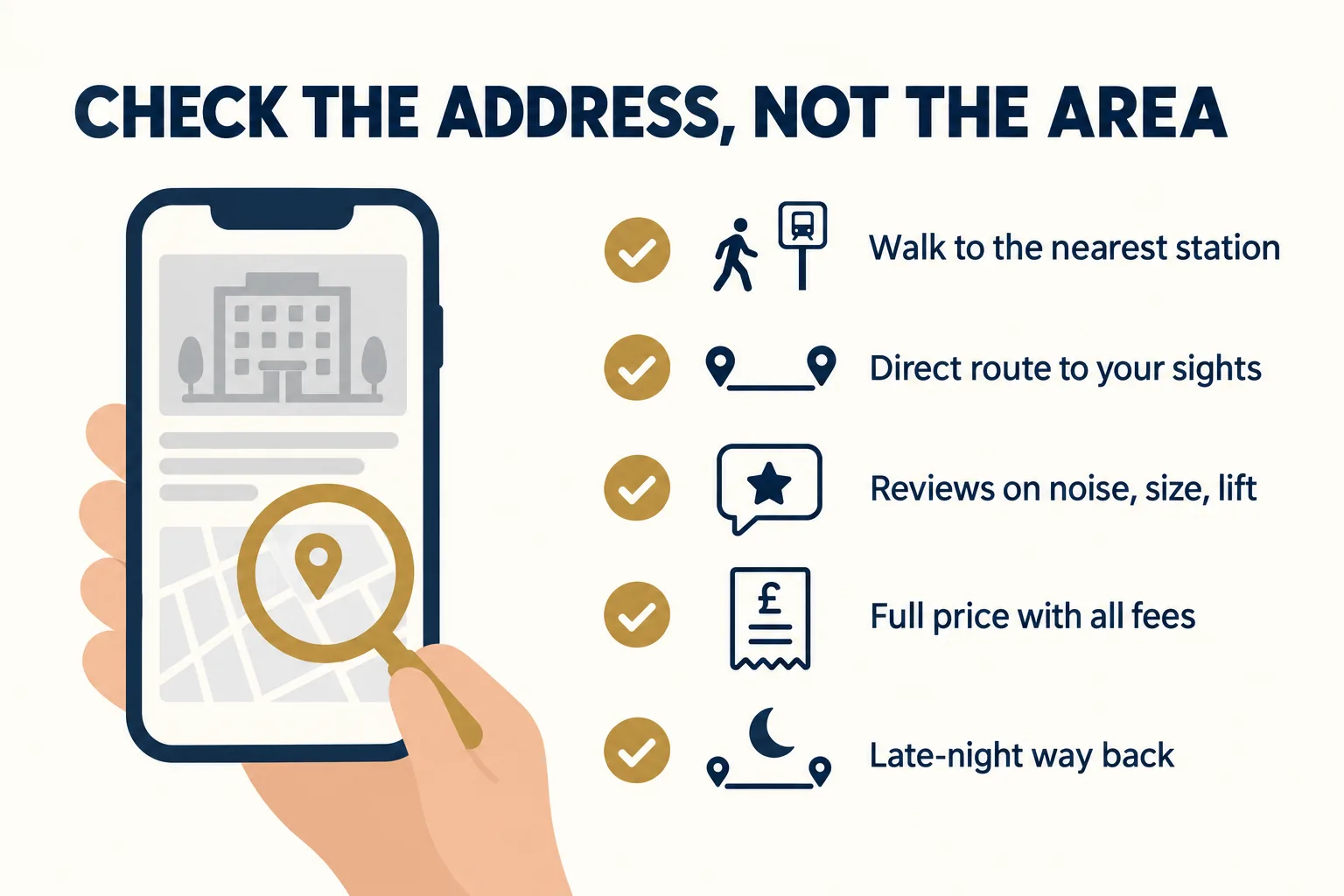
Use the exact property address rather than the neighbourhood name alone.
Check:
- The walking route from the hotel entrance to the nearest station.
- Whether that station has a direct route to the sights or airport you plan to use.
- Recent reviews mentioning street noise, room size, lift access and cleanliness.
- The full price for your dates, including any service charges or other stated fees.
- The return route after your evening plans, including late-night transport options.
Transport, Tube Zones and Airport Links
London’s public transport uses fare zones, and contactless or Oyster pay-as-you-go travel may be subject to daily capping. Check current fares and caps with TfL before travelling. The Tube map is schematic rather than to scale, so compare walking routes as well as station stops; for some short central journeys, walking may be practical.
| Airport | Main rail link | Central terminus |
|---|---|---|
| Heathrow | Elizabeth line, Piccadilly line, Heathrow Express | Paddington, or Piccadilly line stations across the West End |
| Gatwick | Gatwick Express, Thameslink, Southern | Victoria, London Bridge, St Pancras |
| Stansted | Stansted Express | Liverpool Street |
| Luton | Thameslink via Luton Airport Parkway | St Pancras, Farringdon, London Bridge |
| London City | DLR | Bank, Canary Wharf |
TfL lists the Heathrow-to-Paddington Elizabeth line journey at 28 minutes, excluding walking and interchange time. Check the current route and service information for your terminal and hotel. For late arrivals, compare available transport options and book through a licensed provider. P.S. London also has a guide to tipping London taxi drivers.
Safety Considerations When Choosing a London Base
Avoid judging a hotel’s safety from a borough-wide crime total alone; those figures do not describe the risk at a specific address. Check current local guidance and recent accommodation reviews, and take ordinary precautions in busy public places.
Noise and atmosphere vary by street, even within the same neighbourhood. If you want a quieter stay, check recent reviews for the specific hotel and ask about rooms facing busy roads or nightlife. The Metropolitan Police advises visitors to stay aware when using phones in public; see its phone-theft prevention guidance. Keep valuables secure in crowded places and use licensed transport providers.
How to Avoid a Poorly Located London Stay
A lower room rate farther from your plans may come with extra travel time and fares, but whether that trade-off is worthwhile depends on your itinerary and length of stay. Airport hotels can be convenient for early flights or layovers; for sightseeing, compare the door-to-door journey and total cost with a central hotel. More than one change is not automatically a poor choice if the route suits your plans.
Before booking, check the full address on a map, the walk to the nearest station, the lines serving it, and door-to-door routes to two or three sights on your itinerary. Read recent reviews for noise, accessibility, and the condition of the property rather than relying on the neighbourhood label alone.
Budgeting for a London Stay: Room Rates and Extra Charges
| Hotel location | Potential benefit | What to check |
|---|---|---|
| Near your main sights | May reduce some journeys | Room rate, street noise and exact walking routes |
| Central but outside the busiest blocks | May offer a different balance of access and atmosphere | Nearest station, late-night route and total cost |
| Farther from the central sights | May cost less for some dates and properties | Door-to-door travel time, fares and number of changes |
Room rates, room size and journey times vary by property and date. Compare the total price for your travel dates with the route and time needed to reach the places you plan to visit; a central hotel is not automatically better value for every trip.
Check menus and bills for service charges, since policies and percentages vary by venue. Visit London notes that restaurants often add a service charge, usually 12.5%, particularly for larger groups; see its London tipping guide and P.S. London’s guide to tipping in London for visitor guidance.
Dining and Evenings Near Each Base
| Base area | Evening character | Typical night out |
|---|---|---|
| Soho & Chinatown | Dense, late, informal | Pre-theatre table, then late Cantonese or Thai |
| Mayfair & Marylebone | Formal, reservation-led | Tasting menu or a hotel bar |
| Borough & Bermondsey | Market-led, relaxed | Small plates and a wine bar under the arches |
| Shoreditch | Independent, loud | Bar crawl with food along the way |
| South Kensington | Quiet, neighbourhood | Early dinner, walk through the garden squares |
If you are travelling as a group or have dietary requirements, contact restaurants before booking and confirm menus, capacity and reservation terms. Availability differs by venue and date. For evening ideas, see P.S. London’s guide to the best bars in London.
How Many Nights, and How to Build the Days Around Your Base
For a three-night stay, consider a central base if your itinerary focuses on West End and landmark visits; check the hotel’s exact location and price.
For five nights, compare a West End or South Bank base with the routes you expect to take east and west.
For a longer stay, you may prefer a quieter street or a lower room rate, provided transport still works for your plans.
A practical day plan groups nearby sights and leaves time for meals and travel. For a short visit, P.S. London’s London weekend itinerary offers another planning reference.
When a Local Fixer Beats a Second Hour of Research
A neighbourhood guide can narrow the options, but the hotel address, room location and recent reviews still matter. Check these details against your own itinerary before booking.
A London concierge can help plan experiences and coordinate selected bookings, depending on the service and availability. P.S. London describes its local concierge service for London experiences; ask the team what support is available for your dates.
Key Takeaways
Related readingLuxury Hen Party Ideas London: Classy, Bookable PlansRead the guide →| Question | Short answer |
|---|---|
| Overall area choice | Compare Covent Garden, Soho, South Bank and Southwark against your itinerary and dates |
| Value | Compare total room cost with transport time and fares |
| Families | Check attraction access, room configuration and hotel facilities |
| Nightlife | Shoreditch and Spitalfields may suit visitors prioritising markets, dining and late evenings |
| Location check | Verify the exact address, station route and journey to planned sights |
| Safety | Check current advice and recent reviews for the property and street |
| Before booking | Confirm accessibility, cancellation terms and the full price |
Frequently asked questions
What Part of London Should I Stay in for the First Time?
How can I choose a safe-feeling area to stay in London?
Which London area works well for families?
How do I check whether a London hotel is well located?
Is it worth staying in Zone 1?
Plan Your First London Trip Around the Right Base
Your hotel location can shape the time and transport your itinerary needs. P.S. London offers tailored London itinerary planning; ask the team what it can arrange around the accommodation you have chosen. For dining plans, see its restaurant reservations service.
If you want a guided introduction to London, review P.S. London’s private London tours and confirm the available options. Business visitors can also ask about the corporate concierge service.